
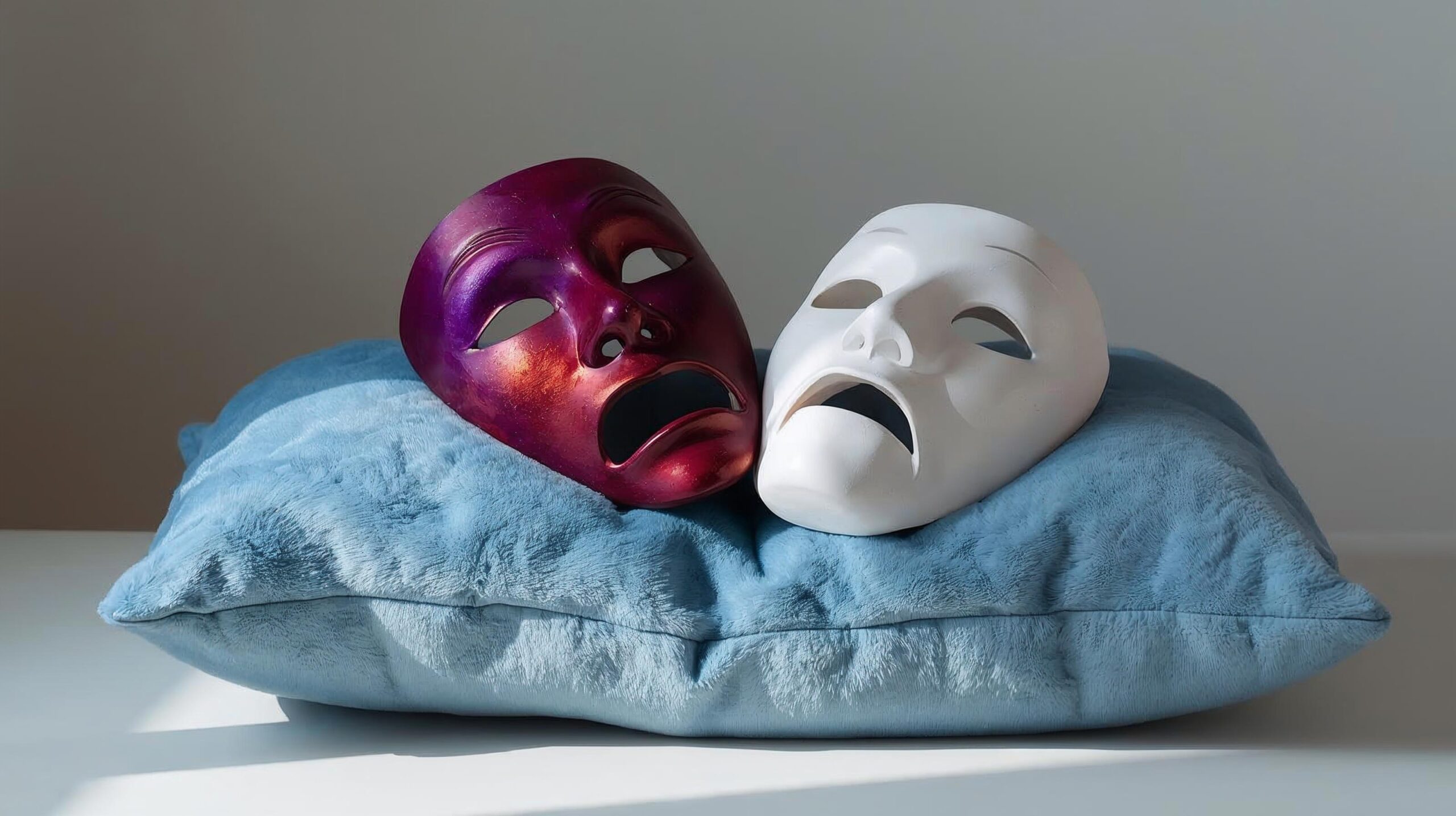
Sometimes, AuDHD unmasking doesn’t look like a big identity revelation.
Sometimes, it just looks like asking for a pillow.
Last night at Aaron’s*, my entire lower body was out of alignment as we tried to snuggle and watch a movie. My knees were uncomfortable, my hips were complaining, and my nervous system was quickly descending into “mysteriously grouchy for no apparent reason.” A previous version of me would have stayed there, silently stewing in discomfort, and then spent the rest of the evening wondering why I was so irritable…possibly even expressing that irritability outwardly.
When I realized how uncomfortable I was, I asked for my knee pillow. Alas, it was not handy, as I hadn’t hung out at Aaron’s for many moons. So rather than suffer in silence, I got up and went hunting for a pillow. Any pillow. (And before you wonder why I didn’t just grab one off the bed…that’s where we were snuggling. So the available pillows, which are much too fluffy to be suitable for knee support, were already being used under our heads.)
And this wasn’t a polite, “Oh, it’s fine, don’t worry about it” kind of hunt. I mean an intense, moving-shit-out-of-the-way hunt to get to a pillow I could see but not easily reach. Aaron also eventually located the actual knee pillow, but the important part was this: I refused to settle for being uncomfortable, and decided I was not going to quietly suffer just to “keep the peace.”
From the outside, especially if you’ve been trained to be low-maintenance, that kind of behavior can look like entitlement.
Who do you think you are, feeling entitled to be comfortable all the time when there are people enduring much worse suffering?
But inside the relationship, it felt like something much softer and more radical: I felt safe enough to not sabotage my own body for the sake of politeness.
Is It Unmasking… or Just Needs?
Here’s the question that’s been bouncing around my brain ever since:
Was that unmasking, or was it just being comfortable enough to express my needs?
For most neurodivergent people, masking is a survival strategy; we hide our needs, censor our reactions, and contort into “easier” versions of ourselves so that other people won’t be uncomfortable. That usually includes pushing through sensory discomfort and physical pain so we don’t seem “fussy,” “high-maintenance,” or “too much.”

By that definition, the old version of me – who would have quietly tolerated hip pain all evening, or possibly even cut the night short because of it – was masking. I would have chosen social harmony over my own literal physical alignment, then likely left his house feeling drained and grouchy rather than having a full happiness battery from snuggling.
The new version of me didn’t do that.
I noticed the discomfort, decided it mattered, and acted on it.
If you zoom out, that’s what unmasking often looks like in real life; not some dramatic personality pivot, but hundreds of tiny decisions where you stop ignoring your body’s (and brain’s) signals to make other people more comfortable.
The “Entitlement” Illusion
From the outside, though, asking for what you need can look suspiciously like entitlement – especially if you’ve spent years training yourself to be low-maintenance.
- Asking for the lights to be turned down.
- Saying you’re done peopling and need to leave early.
- Requesting a quieter table, a different seat, or your water without ice.
If you grew up believing your needs are a problem, those requests feel huge. They feel like demands. They almost feel like you’re throwing a tantrum over something stupid or unimportant.
But here’s the reframe I keep coming back to:
There’s a difference between entitlement and mutual care.
Entitlement says: “My comfort matters and yours doesn’t.”
Mutual care says: “My comfort matters and so does yours – and we’re on the same team trying to make things work for both of us.”
In other words, this isn’t a case of “happy wife, happy life.”
Inside my relationship with Aaron, the pillow moment wasn’t me demanding special treatment. It was me trusting that preserving my comfort would protect the evening for both of us. Without the pillow, my pain would have gradually worsened, my patience would have thinned, and he would have gotten a version of me that was increasingly grouchy and hard to connect with.
With the pillow, my grouchiness evaporated almost immediately. So did the risk of a weird, disconnected night neither of us really enjoyed.
That’s not entitlement. That’s relationship maintenance – for both of us.
The Importance of “Reasonable and Accommodateable”
(Is accommodateable a word? My spell-checker doesn’t think so. Oh well, it is now! Anyhoo…)
I think one of the reasons our relationship works is that we’ve (consciously or not) chosen each other in part because our needs are reasonable and accommodateable for one another.
Not low. Not nonexistent. Just:
- Understandable
- Non-punishing
- Responsive to change
Take Aaron’s tendency toward overstimulation in loud, peopley places, for example. When we’re out and about and he hits his sensory limit, that’s it – we leave. I might not have seen everything I wanted to see, but I’m an adult and can handle that miniscule bit of disappointment. The tradeoff is more than worth it: We cut the outing a bit shorter, and in exchange I get a happier, more emotionally available human almost immediately.
That “almost immediately” is also key. The feedback loop is short and obvious:
- He honors his limit.
- We act on it.
- His nervous system settles.
- Our connection improves.
Same with the pillow. I asked for what I needed, we solved it quickly, and my mood shifted almost as soon as my lower body was no longer yelling at me. The difference between being low-key miserable and trying to hide it all evening and actually being comfortable and present was one pillow and about three minutes of effort.
Reasonable and accommodateable doesn’t mean never inconvenient. It means:
- The ask is clear.
- The benefit is tangible.
- The relationship feels lighter, not heavier, after the need is met.
The Payoff: Everyone Gets a Better Version of Us
Here’s the part that feels the most counterintuitive if you were raised on people-pleasing:
Honoring your needs doesn’t make you harder to love; it makes you easier to live with.
When I advocate for my body instead of silently enduring pain, Aaron gets a partner who is more regulated, more affectionate, and less prickly. When Aaron honors his stimulation limits instead of white-knuckling through crowds, I get a partner who never winds up on the verge of snapping from overload.
We’re both service-oriented by nature. We both like making the people we love feel cared for. That instinct used to mean ignoring our own limits to avoid “being difficult.” Now, more and more, it means making small adjustments so that both of us can actually enjoy the time we’re spending together.
The payoff isn’t just personal comfort. It’s relational ease. It’s that sense of, “We’re on the same team,” reinforced over and over by small, concrete actions:
- Grab the pillow.
- Leave the event early.
- Turn the volume down.
- Change the plan when someone’s nervous system taps out.
These aren’t dramatic romantic gestures. They’re tiny acts of everyday love that keep the relationship from silently accumulating resentment and burnout.

So… What Do We Call This?
Did my pillow hunt qualify as AuDHD unmasking? Was it just being comfortable expressing my needs? Was it both?
Honestly, I’m not sure the label matters as much as the direction of the movement.
If masking is hiding our needs to protect ourselves from rejection, then anything that moves us toward expressing those needs – with respect for our partners and for ourselves – is part of unmasking. It’s how we slowly build relationships where we don’t have to pretend our bodies don’t hurt or our brains aren’t overloaded.
What I know is this:
- I used to silently suffer and then turn into someone I didn’t like being.
- Now, I’m learning to ask for small things that make a big difference.
- I’m incredibly lucky to have partners who don’t treat that as a burden, but as part of how we take care of each other.
What Does All This “Pillow Talk” Have to do With Entrepreneurship?
Well you see…a lot of autistic and ADHD entrepreneurs build businesses the way we were taught to do relationships:
Over-accommodate everyone else. Under-advocate for ourselves. Mask like hell and call it “professionalism.” That can look like:
- Saying yes to every client demand, even when it wrecks your schedule or nervous system.
- Designing a business that fits what people expect, not what actually works for your brain.
- Hiding your sensory, executive function, or communication needs because you’re afraid you’ll look unprofessional.
It’s the business version of “happy client, happy life” – and it leads to the same places: burnout, resentment, and wanting to walk away.
The “pillow moment” is a tiny blueprint for doing business differently.
- Instead of silently suffering through misaligned offers, you design your services and containers to support the way your brain actually functions.
- Instead of hoping for clients who align with your limits, you clearly state your boundaries, processes, and timelines up front.
- Instead of treating accessibility and accommodations as “extra,” you build them in as standard – starting with your own needs, not just your clients’.
In that sense, unmasking in relationships and unmasking in entrepreneurship are the same muscle:
- You stop pretending you’re fine when you’re not.
- You stop making your needs invisible to fit in.
- You start assuming that the right people – partners, clients, collaborators – will actually prefer you regulated, resourced, and honest.
For me, that looks like a knee pillow while snuggling and business offers that are built around my actual energy patterns, not the imaginary “ideal entrepreneur” I thought I was supposed to be. Both are small acts of refusal: I will not burn myself down to be lovable or successful.
And if that looks like entitlement from the outside, I’m okay with that. The people I’m building relationships with and a business for are the ones who understand that mutual care and clear boundaries are not luxuries—they’re the whole point.